A blueberry powder can bring berry flavor and fruit-derived color to a smoothie blend, a yogurt preparation or a private-label pouch. Whether it works at commercial scale depends on the powder’s composition, how it mixes, and how the finished product changes during processing and storage.
This guide follows those questions from bench trials to sourcing. It uses China-Herb’s 100% Natural Wild Blueberry Fruit Powder (100g Stand-Up Pouch), SKU 1602002288344, as the commercial example.
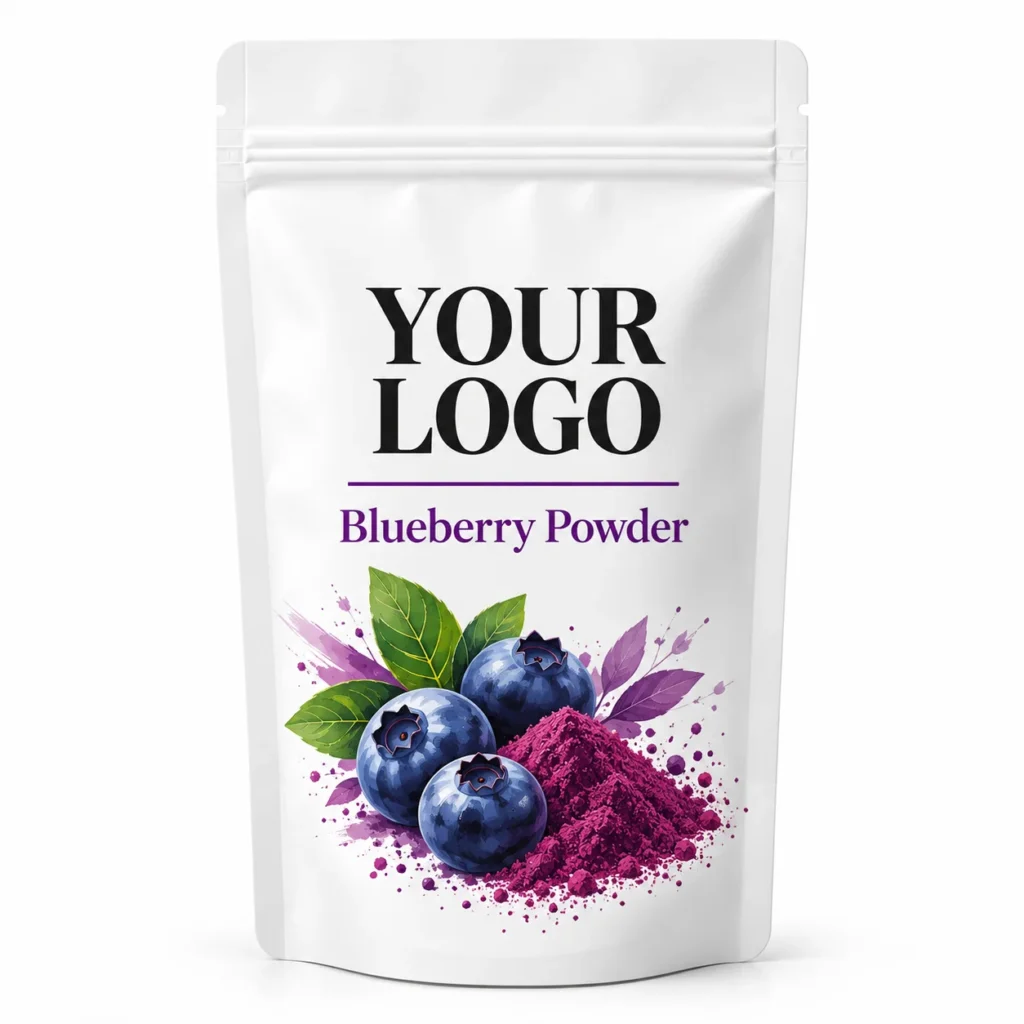
China-Herb catalog pouch mockup. Final artwork and label statements are subject to approval.
1. What is wild blueberry fruit powder?
Blueberry fruit powders can be made from fruit, pulp or juice. The starting material, drying process and any carriers affect flavor, fruit solids and texture. The China-Herb listing identifies blueberry as the main ingredient and describes a powder for private label and OEM projects. Its public specification leaves the botanical species, drying method and full ingredient percentages to be confirmed.
For qualification, request the botanical name, raw material origin, plant part or fruit fraction, and complete ingredient statement. In particular, clarify what “100% Natural” means for the standard formula and whether any carrier, sweetener, flavor or processing aid is used in the quoted version.
2. Flavor, color and behavior in a mix
Flavor. Evaluate the balance of berry aroma, sweetness, tartness and any astringency at the target inclusion rate. A sample that tastes right in water may need a different balance in yogurt, oat milk or a protein blend.
Color. Anthocyanins are a family of pigments found in blueberries. Measure color in the final recipe, because the base color and pH influence the visual result. For a baked or heat-treated product, compare color before and after processing and again at the end of the intended shelf life.
Mixing. Ask for a particle-size specification and test wetting, clumps, visible particles and sediment with the equipment and temperature used in production. A cloudy smoothie and a clear drink have different acceptance criteria, so define the target appearance before requesting a grade.
3. What storage studies tell formulators
Fracassetti and colleagues stored an experimental freeze-dried lowbush wild blueberry powder at four temperatures and observed faster anthocyanin loss at elevated temperatures. For a sourcing team, the practical step is to verify color and any declared pigment level over time in the selected packaging. Fracassetti et al., Journal of Agricultural and Food Chemistry, 2013.
Lavefve and colleagues tracked polyphenolics in several blueberry food formats over eight weeks. Anthocyanin retention varied across the tested formats. The study’s juice and ice pops used a concentrate prepared from the powder, which matters when comparing those results with a whole-powder drink. Use the findings to plan separate stability trials for each recipe. Lavefve et al., Foods, 2020.
These studies identify useful variables to test. For SKU 1602002288344, obtain the supplier’s batch data and run stability tests on your own formula before setting a quantitative anthocyanin specification or making a finished-product claim.
4. Applications worth trialing
Instant mixes and smoothie bowls. Compare aroma, color and sediment in the intended base at the serving temperature. For a smoothie bowl, test how the color reads against banana, yogurt or oat ingredients and whether the powder changes the perceived thickness.
Yogurt, frozen desserts and plant-based alternatives. Screen flavor in the actual protein and fat system. Check color and texture after chilling or freezing, and record any visible separation during holding.
Dry bakery and snack blends. Test the powder at more than one inclusion level in the actual process. Compare a baked application with a lower-heat option such as a filling or topping if berry flavor or color is a priority.
Private-label pouches and sachets. A 100 g pouch provides a defined retail format for sampling or private-label development. Check powder flow and dosing accuracy during packing, and test the proposed pack for product handling and stability after opening.
Catalog illustration of a blueberry smoothie bowl concept. Evaluate flavor and color in your own base.
5. From bench sample to purchase specification
Start by defining the application, base recipe, target color, desired flavor intensity and expected storage conditions. Screen the sample at several inclusion levels with a control. Record mixing order, temperature and time so the preferred trial can be repeated at pilot scale.
Use the same measurements before and after processing. For a beverage, this may include pH, color, sediment and sensory notes. For dry mixes, check blend uniformity, flow and clumping. Set acceptance limits with your quality team and compare the pilot or production lot with the approved sample.
Before buying, request the complete ingredient declaration, technical data sheet and lot-specific certificate of analysis (COA). Confirm which results are available for moisture, microbiology, heavy metals and other relevant limits. Ask for current certificates that cover the proposed formula and production site if the destination market or buyer requires them.
6. Frequently asked questions
Is this powder freeze-dried? The linked listing does not specify the drying route. Ask China-Herb to confirm the process for the lot or formula being quoted.
Does 5 g per serving mean 5 g of blueberry solids? The catalog lists 5 g as the serving size. Request the ingredient breakdown and fruit-solids basis before making an equivalent-fruit or quantitative composition claim.
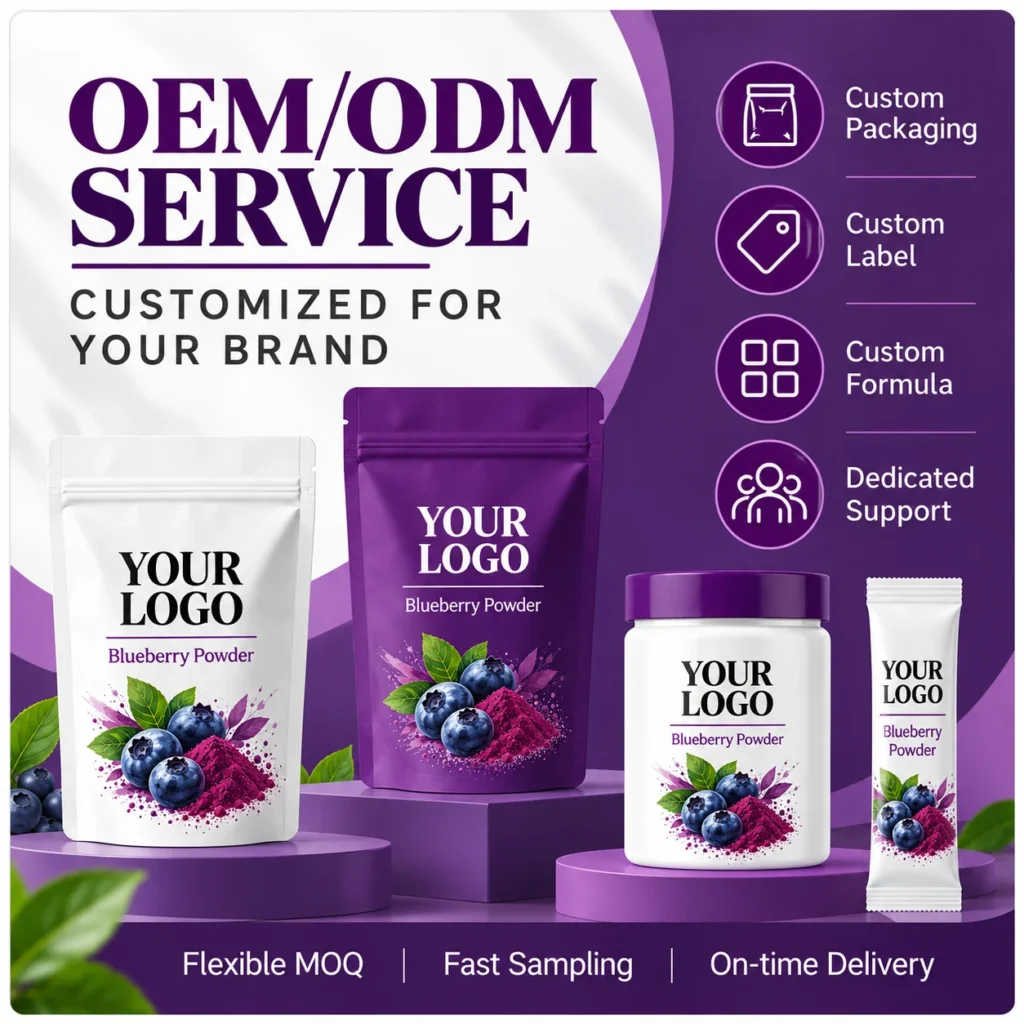
Can buyers request different packaging? The catalog lists custom pouches, sachets, bottles and bulk options. Ask for the minimum order and lead time for your exact formula, pack and artwork.
7. China-Herb’s 100 g private-label blueberry powder
These commercial details are listed for China-Herb SKU 1602002288344. Confirm the selected formula and order terms with the supplier.
Catalog SKU
1602002288344
Main ingredient as listed
Blueberry
Standard format
100 g stand-up pouch
Listed serving size
5 g, equivalent to 20 nominal servings per pouch
Listed MOQ
50 bags. Confirm terms for custom packaging or formula.
Listed shelf life and storage
24 months. Cool, dry storage away from direct sunlight.
OEM options
Formula, flavor, portion size, packaging and private-label design. Confirm feasibility and pricing.
Sources
Fracassetti D et al. Wild blueberry powder storage and anthocyanin decay. J Agric Food Chem. 2013, 61(12), 2999–3005.
Lavefve L et al. Polyphenolic stability in products prepared with freeze-dried wild blueberry powder. Foods. 2020, 9(4), 466.
China-Herb product catalog, SKU 1602002288344.
Request a sample and private-label quote
Tell China-Herb your application, destination market, preferred packaging and expected order quantity. Ask for a sample, ingredient statement, lot COA and a quote for the 100 g stand-up pouch or your OEM format.
View the Blueberry Powder Request a Sample or Quote